Rendering Newark-on-Trent
Silicone Rendering Newark-on-Trent | System & Finish
Silicone rendering is usually discussed as a coloured textured finish, but it belongs to a wider specified build-up. The background, base layers, junctions and decorative coat need to work together. In Newark-on-Trent, a silicone proposal should be assessed against the actual wall and any retained architectural details. It is one possible finish for a suitable project, not a general instruction to cover every old exterior in the same way.

On this page
Separate the surface choice from the construction beneath it
Two walls can end with a similar silicone texture while containing very different systems. One may be a render-only specification over suitable masonry; another may include insulation and its associated fixings and details. The quotation should identify which is proposed. The surface name alone does not establish insulation, thermal performance or the suitability of the background.
The external insulation page describes the broader design when an insulating layer is included. For render-only work, the system still needs a clear component schedule and appropriate preparation. Compatible primers, bases and finishing materials should follow the selected manufacturer's specification. An apparently similar product should not be substituted casually because it has a convenient colour or is available sooner.
It is useful to keep the proposed build-up with the colour approval. That connects the appearance decision to the actual installation rather than allowing the sample to become the only surviving record. If the system changes during procurement or preparation, check whether the approved sample and details still represent it. A shared colour name does not guarantee that two products have the same grain or surface character.
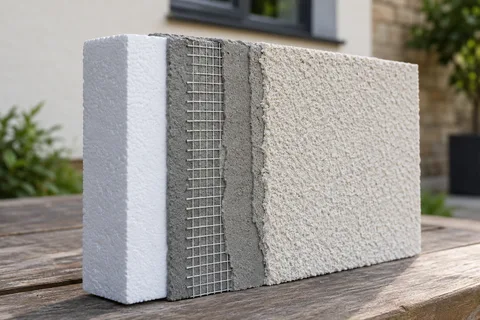
- Sound background A background accepted by the specified system. Keeping old render requires a system-specific assessment of its bond and condition.
- Beads Corner, stop and base beads set the edges and straight lines.
- Basecoat with mesh Glass-fibre mesh embedded in the basecoat resists cracking.
- Primer Where the system requires it, tinted towards the finish colour.
- Silicone finish A thin, through-coloured, water-repellent coat that forms the texture.
Wall on the left, finish on the right. Not to scale: coats, thicknesses and primers follow the chosen manufacturer’s system and the condition of the wall.
Retained render and paint need evidence of suitability
A thin finish cannot provide a sound base where layers underneath are detached or unsuitable. Establish which materials are being retained and how they have been assessed. Existing repairs, paint and patches around altered openings may need particular treatment. Where testing or opening-up is required, identify the question it answers and the decision that follows from the result.
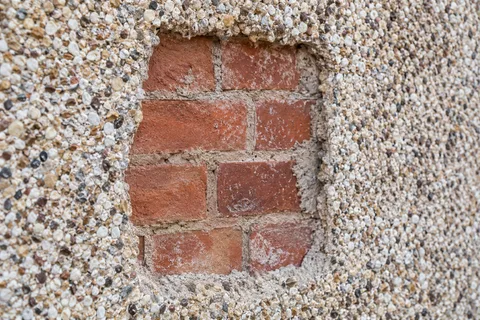
If removal reveals weak masonry or mixed substrates, review the proposal before covering them again. The repair guide explains how local defects can be described, while pebbledash removal covers controlled stripping and the condition underneath. A new silicone finish should not be promised as a way to hide unresolved movement, a persistent leak or a badly attached old surface.
Traditional masonry requires a separate compatibility assessment. The fact that silicone products are used on many modern exteriors does not establish that one is appropriate for a particular older wall. Lime rendering may be relevant where the existing construction calls for it. The choice should be explained by the building and proposed system, without turning local heritage statistics into a diagnosis of every property.
Judge texture beside the details that remain visible
The grain of a silicone finish can affect how a facade reads at close range. In a courtyard or beside an entrance, people may see the material from only a short distance. On a broad upper elevation, colour and shadow may dominate instead. Assess a representative sample in the intended setting and compare it with retained brick, stone or painted joinery.
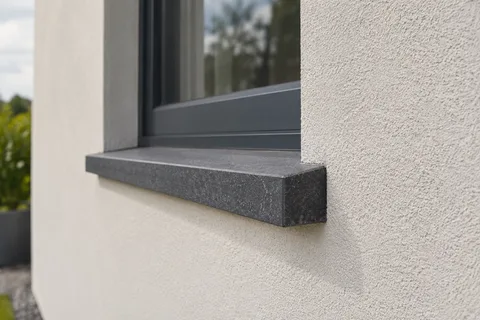
Shallow bands and mouldings need care when the surrounding surface changes. The finish should meet them in an agreed way rather than soften their outline unintentionally. Where a property has planning or heritage requirements, use the relevant approved specification. A familiar pale colour does not mean the texture or detailing is automatically acceptable for a designated building.
The courtyard finish article discusses close viewing and the relationship between shaded and exposed areas. If only one wall is treated, consider the join to the neighbouring finish. The wall-rendering page explains that extent decision. A sample held in isolation cannot settle how a new panel will look when it ends beside weathered material of a different texture.
| Record | Reason to retain it |
|---|---|
| System component schedule | Identifies the build-up beneath the colour |
| Background assessment | Explains what was suitable to retain |
| Texture approval | Defines the intended grain and appearance |
| Care guidance | Supports compatible future treatment |
Organise the application around the real elevation
Corners, openings and specified joints affect how the finish is divided and applied. The competent team should plan the working sections and any suitable stopping positions. A visible break should follow the design rather than appear accidentally because an elevation was larger or harder to reach than expected. The access arrangement must allow the specified work to be completed consistently.
Application and curing conditions come from the product guidance and the actual site. Direct sun, wind, rain and temperature can affect the decision to proceed. There is no reliable fixed programme based solely on the wall area. Explain how unsuitable conditions will be handled and how the work remains protected during a pause. The owner should understand the contingency before a weather-related change is treated as a surprise.
Rainwater and other fittings should be dealt with in the correct order. A leaking joint above the wall or a sill with an unresolved projection can affect the finished surface regardless of its decorative properties. The article on coordinating rainwater repairs sets out that sequence. Silicone terminology does not remove the need to maintain the building's water-handling details.

Leave a finish that can be maintained and identified later
At completion, retain the product, colour and texture references and the relevant care instructions. Cleaning methods need to suit the installed finish; an aggressive treatment should not be chosen just because it removes a mark quickly from another material. If growth or staining recurs in one location, inspect the surrounding conditions instead of repeatedly treating the appearance alone.
A later colour change may be possible with an appropriate recolouring specification, but compatibility and background condition still need assessment. Damage from future fixings or alterations should also be repaired with reference to the original system. A generic exterior filler may not provide a suitable repair to every layered facade, even if it can be painted a similar colour.
For a wider exterior scheme, house rendering places the finish within the relationship between all elevations. For a mineral textured alternative, compare monocouche. The Rendering Newark-on-Trent homepage keeps these choices alongside lime, repairs and insulation so the decision can be made from a suitable specification, with the decorative finish understood as part of the work rather than the entire answer.
Common questions
Does a similar colour mean two silicone products are equivalent?
No. Grain, surface character and system requirements can differ. A proposed substitution should be reviewed against the actual specification and appearance approval, rather than accepted solely because its colour name resembles the original choice.
Can silicone render cover an unidentified old coating?
The retained layers need assessment before a suitable build-up is specified. A new decorative finish depends on the background beneath it. Testing, removal or other preparation may be required; the finish name does not settle that question.
See housing and planning information for Newark-on-Trent and nearby places, including the source and geography behind each figure.